Word by Word

Creating myself one word at a time.

Stacks of books

There is a corner of the Internet where I spend a lot of time. It’s the corner with the readers and writers of books. It’s the place where you hashtag “amreading” or “amwriting” proudly. It’s the corner where people support each other with writing sprints or beta reading their work.

This corner of the Internet blew up the other day over an article written by a woman for Salon about why adults should be ashamed to read books written for the young adult age group. I enjoyed seeing some of the top YA writers on Twitter turn the criticism around by recommending their favorite YA instead (see #PromoteaYAInstead).

All in all, it was a big kerfuffle.

I wasn’t going to read the article. I swear. Then I started thinking about my own reading habits and preferences. Then I became endlessly curious about what this woman, Ruth Graham, actually said in her article. I broke down and read it. I also spent some time perusing the other articles she written over the years. They create an interesting picture of her views on the world. But, I’m not going to attack the writer of the article for her views. Instead, I’m going to respond to a couple of her main points.


Reasons Why I Read It

There is a confession I need to make up front. As an English major in college, I had serious book prejudices. In most cases, if the author was still alive then the book or work wasn’t worth reading. There were a few living authors on my list. Salman Rushdie. Barbara Kingsolver.

I clung to this prejudice for a few years. Then I started reading some contemporary fiction. Then I read more. Then I started reading YA with my own teenager. Now, I make it part of my regular reading list. Who changed my mind? Cornelia Funke. Alyson Noel. Laini Taylor. Libba Bray. Ransom Riggs.

Not all YA is created equal to be sure. This makes it just like adult fiction in my mind. I’ve read some adult fiction, genre and literary, which made my eye twitch. Some of it made me close the book and think “well, won’t be getting that three hundred pages back.”

But, oh, those gems where you finish the book and you sit back with the knowledge that your world has just shifted slightly. It is those moments, as a reader, I live for and relish. And some of those books, for me, have been written for a YA audience. Does that make me a less discriminating reader? Does it mean I need to eat Happy Meals? No, it means I haven’t allowed a prejudice keep me from opening my mind to truth or diversity in the form of a young adult novel.

As an adult, reading YA can provide nostalgia, but that isn’t the only thing that an adult can gain by reading them. What’s wrong with reading YA to connect with those in middle school and high school today? To understand their world just a little?

I think every adult has at some point thought “I can’t imagine going through high school in today’s world.” Whether it’s the school shootings or the online bullying or the spread of news about some bad decision through social media, young adults today are facing a world that I don’t always understand and one that I want to be able to help them navigate. Reading has always been an avenue of learning for me. So, if young adults are flocking to a certain novel then they are seeing something of their reality depicted there. Sign me up.

I also love it when my 14 year-old comes running to me to tell me to read a book she’s just finished because it made such an impact on her. And she knows that I’m going to take her book recommendation seriously.


The Ending Thing

There was one part of Ruth Graham’s article which rankled even more than the rest. Her generalization about YA endings seemed a bit…hypocritical. I’ve read a few adult fiction books where I’ve been disappointed that the ending was so neatly wrapped with the big, red bow. There was no courage in adding a bit of edge to the end.

Graham’s argument did make me wonder about how many YA books she read to come to this unfair conclusion. In rebuttal I’m going to offer one YA series that ended in heartbreaking reality. Libba Bray’s Gemma Doyle trilogy. Set in the Victorian era, the main character Gemma falls in love with a young man who is South Asian. Now, I know as an avid history buff that no relationship between an English young lady and an East Indian young man could ever end in marriage in the 1890s. And Bray knew this as well. I won’t give away the ending, but our dear Gemma had to face her future alone and she did it bravely.

I think my favorite tweet from the whole dust-up came from Annie Stone.
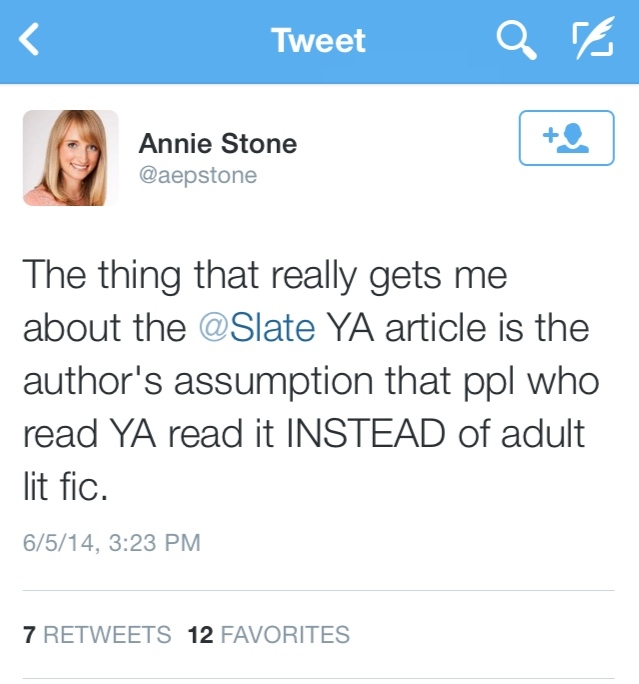
 

Annie Stone tweet


Now, I will offer one bit of advice to Ruth Graham. She should have her eyes checked. If they are rolling that often, there may be a problem. Or she may be emulating those young adults she thinks are reading such simplistic fiction.

Now, if you’ll excuse me. I have a stack of books that includes YA, non-fiction, genre adult, literary adult and a Magic Tree House, to read.
The other day my sister, mother and I were putting a puzzle together. Yes, a jigsaw puzzle. As all three of us are goal-driven, Type A personalities, puzzles are something we all enjoy because, in the end, you can see that you’ve completed something. That’s a topic for another time though.

While we were working on this puzzle, my sister turned on some music. It was a remix of an album of worship music. Most of the songs were good, but then this one song came on and I stopped puzzling in my tracks and just listened.

The first lines went:

You call me out upon the waters

The great unknown where feet may fail

And there I find You in the mystery

In oceans deep

My faith will stand


It was beautiful. Here is a more acoustic version.


And here is the remix version that I’m loving right now.

MothersDayPresent

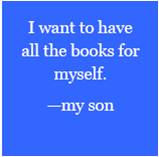
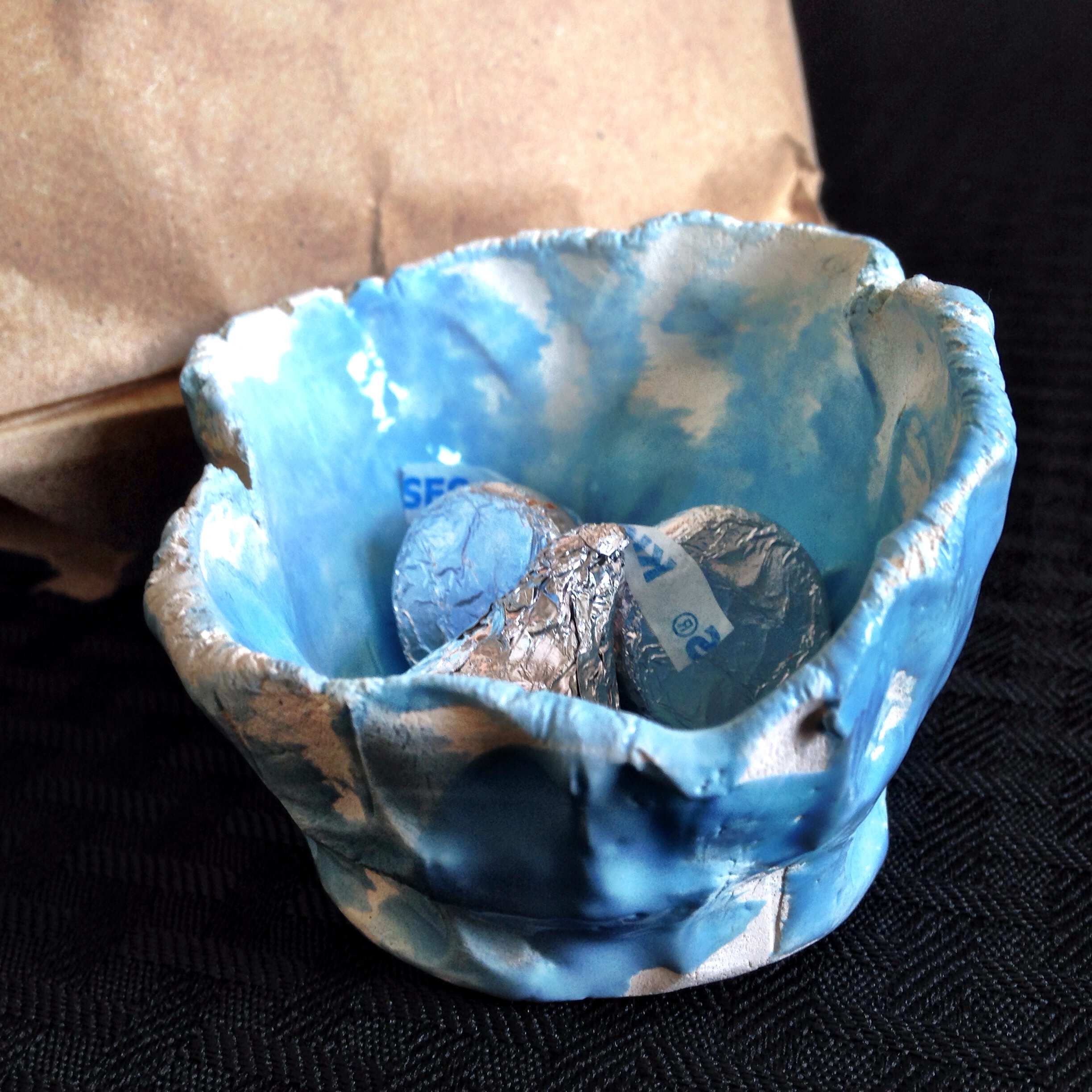
This little piece of pottery was my gift from my six year-old. He was so proud.

Cringing when I entered my password for this blog, I knew the date of my last post would be staring at me from the screen. Guilt, predictably, was the emotion I felt. Three months. Three. Somewhere in the middle of February I lost focus…or steam…or ability to manage my time. Whatever the problem, I went on radio silence.

Day followed day. Get up. Go to work. Come home. Do homework with kids. Clean up dinner. Sleep. Repeat.

Now, it is May. I have to admit. I was dreading May. It is the month of my birthday, Mother’s Day, end of school craziness and it just has a lot of obligations. Something interesting happened though.

I found the steam. Was it the spring weather? The sun coming out? Getting my hands back in the front garden? The excitement I sense in my kids about summer and the end of school?

Whatever it was, I’m thankful. Like Stella, I’ve found my groove.

And my sweet Mother’s Day gift from my son didn’t hurt. It was a pleasant surprise when he woke me up at 7 a.m. to give it to me. He’d been waiting for four days and was too excited. I think his excitement for life is contagious.

It also got me thinking about a quote I came across:

“You can’t just plan a moment when things get back on track, just as you can’t plan the moment you lose your way in the first place.” –Sarah Dessen

I don’t know if this is “back on track.” It will be important to not go into radio silence now, but to stay plugged into life and the excitement of everything around me…even the small things like a little blue bowl.


Quote

QuoteIt’s hard for me to remember the days when I was learning to read. It’s been nearly thirty years since those times. I think my lack of memory is compounded by my avid reading. A case of reading so much over the years that it’s hard to remember where I began.

All of that probably explains why I’ve been so fascinated with my son’s progress as he’s been learning to read over the last year or so. We’ve progressed from learning the letters to their sounds to building words. Now, he’s starting to read simple books on his own. It is a fascinating thing to watch. The connections he makes in his mind. The memorization of certain words.

Over the last couple of months he’s attempted reading signs, notes from school, words on packaging. You know, the pragmatic reason to read.

But, we’re also reading chapter books with him and we’ve made it a few books into the Magic Tree House series. Each night we open the pages and enter into a new world and he loves it. When we read the book about pyramids, he wanted me to find out more information about ancient Egypt. The current book about ancient man has us looking up pictures of prehistoric cave bears to see just how big they really were.

He is learning the lesson that, I hope, will make him a lifetime reader. The magic for me, though, is watching a new reader learn this magical trick of stepping outside yourself to learn about other people, other times and other cultures. You also learn that you aren’t as different as you think.

It reminds me of a James Baldwin quote I read once:

“You think your pain and your heartbreak are unprecedented in the history of the world, but then you read. It was books that taught me that the things that tormented me the most were the very things that connected me with all the people who were alive, who had ever been alive.”

That may be a little heavy for a six year-old, but it is a lesson he’s just beginning to learn. I’m excited to see his journey as a new reader and to watch him mature.

Just in time for Valentine’s Day–a day celebrating all things love–I have discovered a musical group that is all about the dark issues surrounding love. Daughter. I love their raw lyrics. I love the way they tie the lyrics to the music. The lead singer’s voice is at times like Florence + the Machine and others a little more raw. How have I not heard them before!?

So, if you’ve ever faced the side of love requiring its own special Hallmark card section–one where the cards are more black and use words like “gut wrenching”–you’ll enjoy their music.

I know they’re being added to writing playlists by myself and Nicole Evelina!

Below is the video for “Still.” This is one of the songs from their most recent album “If You Leave.” Powerful combo of music and image.

The Eulogy

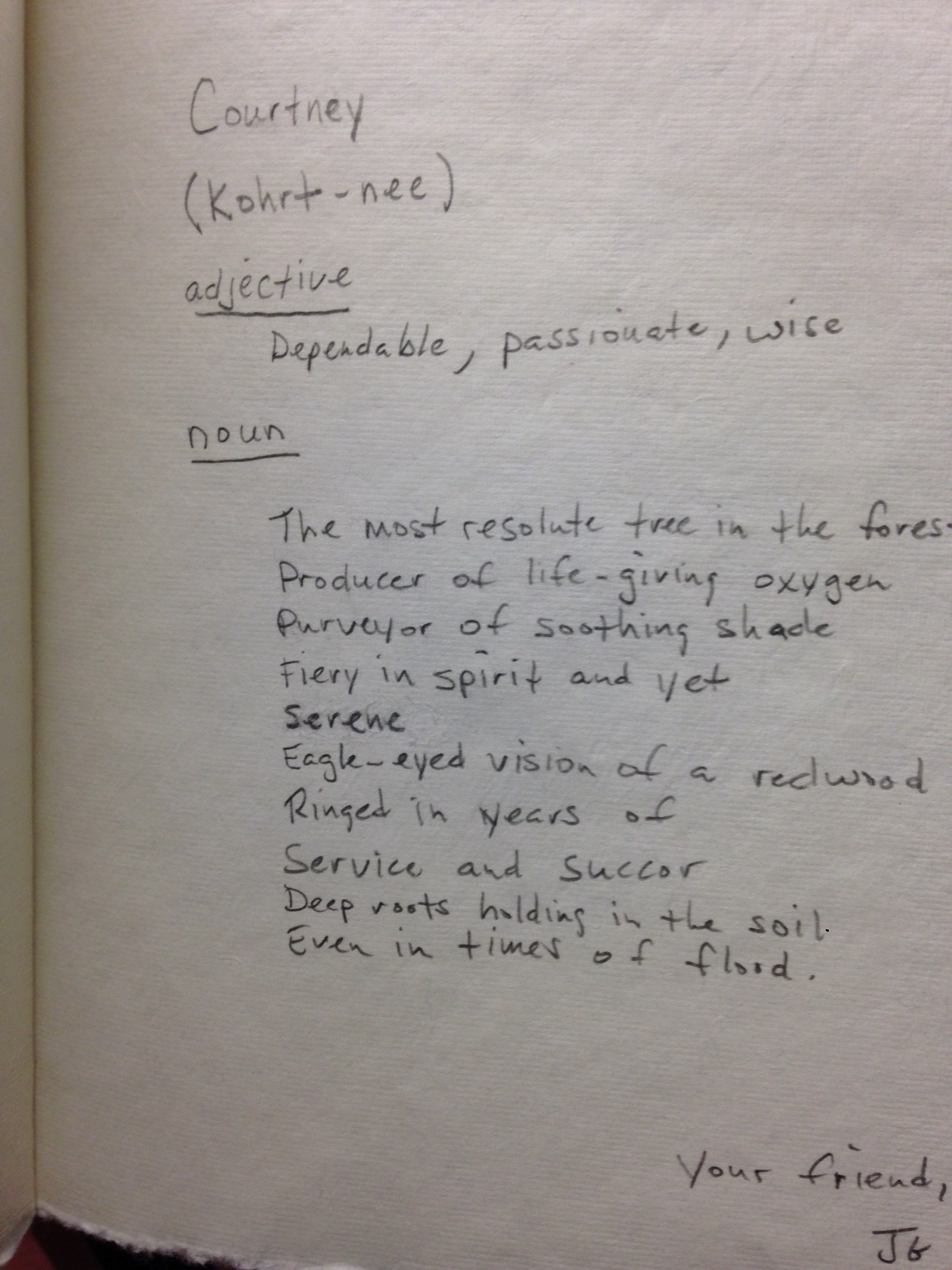
One of the entries in my “anniversary” journal at work. I work with such creative folks.

Not long ago I was honored at work for my fifteen year anniversary of employment there. Along with a catalog of nifty gifts to choose from, they also passed around a journal and wrote entries to me or about me. Then on the actual day they took thirty minutes of a meeting to say wonderfully nice things about me.

It was, upon reflecting on it, a bit like being at my own memorial service. It was something many people may never get to experience while alive. There were a couple of themes that emerged from both the journal and the things they said.

The main theme was passion. That word was used a lot, but so were “zest for life” and “enthusiasm.” It was a little surprising to me. If I were choosing the theme for me I’m not sure it would have been so pleasant.

What was even more interesting were the ways my fellow co-workers said I show this passion. Some talked about the tone in my voice when I talk about something exciting. Some talked about my laugh and the contagious nature of my excitement. Many talked about my stories, both the content and the way I tell them.

I say all of this because it wasn’t until I was reading one of my January reads, “The Negative Trait Thesaurus”, that I started to connect some dots on character development.

Suddenly, I began looking at the characters in my fictional world and wondering what would their fellow character say about them at their memorial service? What stories would they tell to drive home their point that their friend or family member was kind or mature or giving or any other personality trait.

Now, the memorial services I’ve attended often sweep over those aspects of a person’s nature that are more negative and play up those that are more positive. But, sometimes positive traits, if taken far enough, can turn into something not very pretty.

My passion? It can turn from enthusiasm or zeal to fanatical or single-mindedness or obsession. It probably has on several occasions.

The exercise I’ve been taking myself through is a series of questions.

  • What one word would others use to describe them? Often, everybody in their world will come to the same conclusion, maybe not using the same exact words. What is that one word?
  • What story would they use to illustrate their point? This may be back story and may never make it into the novel, but learning the story will help me dig into the actions and expressions.
  • What negative trait are they sweeping over in their attempt to eulogize their friend or family member? Listen to the story they tell, what part is funny or uncomfortable? Which part feels like their covering a deeper meaning?
  • When the family and friends are gathered at the coffee and cookie table after the memorial service, what are they saying to each other about the character? You know, the whispered stories or quietly stated sentiments.

Some other great resources on character development:

The 9 Ingredients of Character Development” by Chuck Sambuchino

Character Baking” on Black Ophelia’s blog.

Create your characters from different moulds” on Roz Morris’ blog.

Stars

This quote made its way around work the other day. It now hangs on the wall where I can read it everyday. It is a beautiful image, the bright shining thing in each of us.

Do all the other things, the ambitious things–travel, get rich, get famous, innovate, lead, fall in love, make and lose fortunes, swim naked in wild jungle rivers (after first having it tested for monkey poop)–but as you do, to the extent that you can, err in the direction of kindness. Do those things that incline you toward the big questions, and avoid the things that would reduce you and make you trivial. That luminous part of you that exists beyond personality–your soul, if you will–is as bright and shining as any that has ever been. Bright as Shakespeare’s, bright as Gandhi’s, bright as Mother Teresa’s. Clear away everything that keeps you separate from this secret luminous place. Believe it exists, come to know it better, nurture it, share its fruits tirelessly.

–George Saunders, Convocation address, Syracuse University, Class of 2013

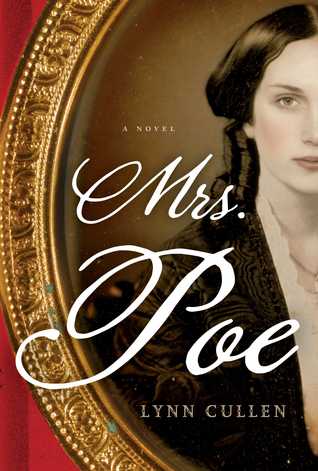
Mrs. Poe

Mrs. PoeI wouldn’t call myself a great fan of Edgar Allen Poe. I read the requisite stories and poetry in high school. You know the drill. It’s Halloween and your English teacher pulls out “The Raven” or “The Tell-Tale Heart” and they try to be all spooky. As a modern teenager you think “um, what?” and your teacher is all “think about the mind who made this up and how freaky he is.” My teenage daughter gets his darkness much more than I did when I was her age.

It wasn’t until my senior year of high school and my college English classes that I figured out just how unusual Poe was. It’s all about context. It’s all about understanding him in his element. It’s also about understanding death and darkness.

Lynn Cullen’s “Mrs. Poe” does a wonderful job setting the scene of Poe’s world right after “The Raven” was published. It was a world being drawn into the Industrial Revolution and Poe’s world is full of people pushing the boundaries of the acceptable.

Mrs. Francis Osgood, a poet in her own right, has been left by a philandering portrait painter and needs to make a living to raise her two girls. Francis is struggling with her creative muse and is told by a publisher to try her hand at the frightening like Mr. Edgar Poe’s work. Poe’s poem “The Raven” has become such a smashing hit that even the children on the street are quoting it. Francis jokes with the publisher that she should write like Poe and be known as Mrs. Poe.

Francis, a periphery member of creative society, rubs shoulders with people like Louisa Alcott, Matthew Brady and Walt Whitman. Many of these people would find great fame later, but in 1854 they are all trying to push forth new ideas like transcendentalism and abolitionist thought.

It is in this setting that Edgar and Francis meet. Poe becomes a great supporter of Francis and asks her to meet the real Mrs. Poe, his cousin ten years his junior, who is either immature or mentally troubled. Edgar and Francis’ attraction moves from mere creative appreciation to passion. The real Mrs. Poe watches all of this with a cunning you do not expect.

Cullen plays out for the reader what might have happened that year they met. It is historically recorded that Francis Osgood was Poe’s mistress and Cullen brings to life a frightening tale of how it might have happened.

I read this book in a 24 hour period. When I finally turned the last page, I reflected on my surprise at how dark it was. It should not have surprised me one bit and, yet, after reading Francis account of her affair I was left with a chill. There could be no happy ending, for we all know Poe’s life was anything but happy.

One of the interesting opinions Cullen shares through her story is that Poe brought the darkness of his childhood with him into his adult life by marrying Virginia, his cousin. Not only did he marry a child, she was a mere 13 year-old, but he strapped himself to a person who was not yet able to mature. Every day Virginia served to remind Poe of the death that followed his family and the loss he’d experienced.

At one point, Poe talks about the soul.

“If by a soul one means the creature who lives within each of us, a creature born loving, born joyful, but who with each wordly blow shrinks more deeply into its shell until at last, the poor desiccated thing is unrecognizable, even to its own self, yes. I do.”

His world was dark. I believe, based on Cullen’s tale, Francis brought a lightness to his world that he desired. More than a light, she brought a normalcy he lacked. Francis could absorb his dark and shine light in his life.

Yet, having said all of that, he chose the one person he could never truly have. He chose a path which would inevitably end in loss and pain.

This leads me to the other thoughts floating in my mind as I finished the book. This book is not merely about a love affair ending in pain. It is also about the intersection of creativity and the mind. Now, many years after high school, I understand why Poe’s tales were so shocking. He brought to life questions of morality, death and pain. When you compare him with his peers of the time, Whitman or Thoreau, it is shocking that he would so reveal the inner workings of the human mind.

Cullen’s “Mrs. Poe” is a superb read whether you’re looking for a story about human desire or just a frightening read about madness.

Books

I may have set some kind of record this month—a personal record anyway—in the number of books I consumed. And, yes, I’m using the word consumed on purpose. My mom has always said I devour books, that I should slow down and enjoy them. I do enjoy them! Just at a quicker pace than most.

Now, I’m no speed reader. I met one once. The number of books she was able to move through was astounding. The last two years I’ve been too optimistic with my Goodreads reading goals. This year I went with the number 50. That’s less than one book a week and seemed doable, even when I have a week of a reading drought.

In the month of January, I read 10 books. TEN. I’m very impressed with myself, if you can’t tell. I have and plan to review some of those books on this blog. I thought I’d give a quick recap of them and some recommendations.

On my list were some non-fiction writing books, historical fiction and a surprise YA. I don’t think I’ll read ten books every month, but I’ll do a quick recap each month.

Fiction

Lady MacBeth“The Lady Macbeth” by Susan Fraser King

This novel is the story of the real Lord and Lady Macbeth. Set in Scotland in the 11th century, the narrator of this tale is Lady Gruadh, or Rue as she’s called. She’s in the distinct role of last in Scotland’s royal line. She’s also passionate about the Celtic tradition of warrior queens. When the death of her first husband leads to a marriage to Lord Macbeth, the two become an ambitious force.

I ended up loving this book. It was tough at first with the names of the people, the various chieftains, the political intrigue between the Scots, Saxons, Vikings and others. It took me a bit to find my footing, but the story of Lady Gruadh quickly pulled me in with its war, magic and descriptions of a harsh, amazing land.

The Name of the Star“The Name of the Star” by Maureen Johnson (Shades of London #1)

I follow Maureen Johnson on Twitter and I find her hilarious. I’m sure her humor may not do it for everyone, but I find her antics great for a laugh. Deciding I needed to read one of her books, I found my library had an “e” version of this book. It’s the first in a series and I plan on reading the others.

The story centers on teenage girl Rory Deveraux, who moves from Louisiana to London at the start of her senior year in high school. Johnson’s descriptions of Rory’s reactions to life in the UK were hilarious. Even as an adult, I could totally relate to her moments of clumsiness or making silly cultural mistakes. When I picked up the book, thinking it was set in Jack the Ripper’s 1880s London, I was shocked to see it was set in current day. I wondered how she was going to connect the two and I was impressed with the results. Johnson, also, clearly did a lot of research for this book. This is a paranormal YA, but one anybody of any age could enjoy.

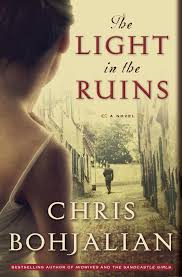
The Light in the Ruins“The Light in the Ruins” by Chris Bohjalian

I’ll admit I’ve never read anything by this bestselling author, so I decided to try this novel. It is a dual time period story, which I seem to gravitate toward naturally. Basically, this story outlines the effects of war on a family and those around them in Tuscany during World War II.

It has been more than ten years since the Nazi retreat from Tuscany as the allied soldiers made their way through Italy. Someone begins killing the surviving Rosati family members. While Serefina Bettini, a Florentine police investigator, tries to figure out who the murderer is in 1955, we are privy to flashbacks to the eventful year of 1943. I struggled at first to understand how the tales of 1943 and 1955 were going to fit together, but Bohjalian orchestrated their coming together like a master. The story is a haunting one, full of sadness and regret.

“Longbourn” by Jo Baker

This one will be on my “favorite reads of 2014” list for sure. Superbly written and executed book. If you’d like to know more, you can read my earlier post.

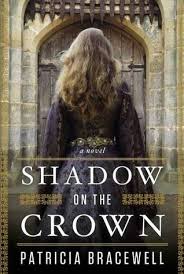
Shadow on the Crown“Shadow on the Crown” by Patricia Bracewell

This was my second book this month set in 1000s Britain. This book, unlike Lady Macbeth, centered on the southern part of the island. Young, like 15 years-old young, Emma of Normandy is married off to the older King Athelred of England. It is a political marriage made without Emma’s consent and she’s soon shipped across the channel to a foreign court not eager to greet the Norman bride.

Emma is made of firmer stuff than I and faces a king grappling with demons, a brood of children from his first marriage who aren’t eager to see her bear her own children and courtiers who resent her title of queen. Emma, who has a talent for language, has a Dane for a mother, a Norman for an uncle and is the English queen. She is smart and observant. Where I would be climbing the walls of my social standing, she learns to wait and watch, biding her time. You can’t help but root for her, facing all the odds of a woman in 1002.

There is another woman in this book who fascinated me. She was a courtier, the daughter of a powerful lord, named Elgiva (rhymes with Godiva). She craves power, unlike Emma who had it thrust upon her. I couldn’t help but think Elgiva would have made a great Wall Street CEO today.

The fact that Bracewell’s story is woven around the true story told in the Anglo-Saxon Chronicles is even more amazing. This is the first in a trilogy about Emma and I look forward to reading more. Check out my friend Nicole’s great review of this book.

“Mrs. Poe” by Lynn Cullen

I’ve wanted to read this book since it was published in the fall. I finally put it on my “reserve” list at my library. When I started this book, I could not stop. I’ll post an extensive review of this book later this week. It is dark. It is engrossing. It is a dive into madness. Very fitting for the story of Poe.

“13 Little Blue Envelopes” by Maureen Johnson (Little Blue Envelope #1)

This was my pleasant surprise this month. I needed an audio book for a road trip and grabbed this one from my library. I’d enjoyed Maureen’s “The Name of the Star.” While this book isn’t as strong as TNotS, it was the message of the book I enjoyed the most. I’ll post a complete review in the next couple of weeks.

“The Reincarnationist” by M.J. Rose

Color me intrigued by the concept of this book. A man, as a result of an injury, begins to have flashes or “lurches” of the past. Not just any past, but the past of a Roman priest in 391 AD. A mixture of Dan Brown meets New Age, Rose uses a cast of seemingly disparate characters to weave the story of an ancient treasure, rumored to help you see your past lives, brought to light during a modern archeology dig. Josh, the hero of the piece, is reeling from the past life lurches he’s experiencing and the feeling that he somehow needs to use that knowledge to right a wrong. He, along with others, is racing to uncover the secrets of the ancient treasure. Josh’s goal is to keep it out of the wrong hands.

This book goes beyond just a dual time period novel. There are several time periods and because people in the current day story are lurching back and forth, there are moments when it can be a challenge to keep track of where you are. The ending left me feeling a little unsure of exactly what happened.

Non-fiction

The Negative Trait Thesaurus“The Emotion Thesaurus: A Writer’s Guide to Character Expression” by Angela Ackerman and Becca Puglisi and “The Negative Trait Thesaurus: A Writer’s Guide to Character Flaws” by Angela Ackerman and Becca Puglisi

These books were on my Christmas list and I’m so glad I got them. I didn’t think they were really going to be a “read” and more of a reference book. However, I sat down with them to get to know them, so I would know when I needed them. So glad I did. They offer great advice on getting to know your characters and what makes them different. I loved the emotion book, but the negative trait book had some great tools in the appendix. I’m already using the character pyramid to better dive into my main character’s, and supporting character’s, motivations, goals, flaws and virtues.