
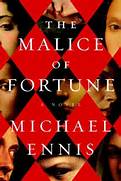
 Michael Ennis’ The Malice of Fortune had two things going against it when I started reading it.
First, it deals with Rodrigo Borgia, also known as Pope Alexander IV, and his family’s reign in Italy. I know very little about this period. I knew this going in and bought it with eyes wide open.
However, I did not know it was written in the epistolary style. I hate epistolary novels (I blame Samuel Richardson and his novel Pamela, which nearly undid me my freshman year in college). So, I sat there on the first page of the first chapter looking at the letter written by Niccolò Machiavelli to some Italian guy I’d never heard of and asked myself if I should keep going. I did keep going and, in the end, was very happy that’s the decision I made.
Just a quick recap: this book is based on the actual historical events that took place in Italy during 1502. The book features some heavy hitters historically. Rodrigo Borgia, the pope, is still trying to determine who murdered his favorite son, Juan, five years earlier. This whole murder matter is dredged up because a woman is murdered in the town of Imola and a charm Juan used to wear is found with one of her body parts, and yes I did say parts because they didn’t find her whole.
Rodrigo kidnaps the son of the famous courtesan Damiata to coerce her into helping discover Juan’s murderer because he kind of suspects she may have something to do with it. Damiata’s son is also Rodrigo’s grandson and Juan’s son.
Damiata goes to Imola and begins her investigation and is quickly joined by Niccolò Machiavelli, of The Prince fame, and Leonardo Da Vinci. Machiavelli is there as a Florentine diplomat and Da Vinci is serving as an engineer. We also meet Cesare Borgia; Rodrigo’s other son who is also known as Duke Valentino. There are a host of other foul men who are in a battle for control of Italy with the Duke.
Damiata , Machiavelli and Da Vinci undertake an investigation into the deaths of women who are chopped up and placed in intricate patterns within Imola. Of course, this game intrigues the great minds of Machiavelli and Da Vinci who struggle to determine who is doing it, each using their own scientific methods. I won’t go any further because, well, spoilers.
So, how was I able to overcome my aversion to epistolary novels? I think it was Michael Ennis’ use of Damiata as the narrator for the first section of the book. We read, in a written letter to her son, about what happens and why she risks all to uncover the murderer. Ennis achieves a letter that is both a heartfelt plea to her son to understand and is a realistic explanation of who she is and how she has made her living. You feel her pain as a mother, worrying about a dear child being in the hands of a viper.
Machiavelli is the narrator for the last sections of the book. He takes up the story where Damiata’s ends. After feeling so deeply with Damiata, I was worried about continuing the story with a male narrator. However, I quickly came to love Machiavelli who is not shy about sharing how he was drowning in the political turmoil surrounding the Duke and trying to protect Florence from invasion. He is but a lowly secretary and not even an ambassador.
Within a few chapters it became clear why Ennis uses Machiavelli as the narrator for the second section of the book. It turns out Damiata may or may not be a very trustworthy source and we have to see her role through Machiavelli’s eyes.
Ennis succeeds in vividly painting larger than life historical figures as very real, flawed humans. I saw Da Vinci’s brilliance and eccentricity in full light. I felt the fear others of that time must have felt when I read about Rodrigo Borgia and his son Duke Valentino. Most interesting to me, I had fun getting to know Ennis’ Machiavelli and understanding why he wrote The Prince.
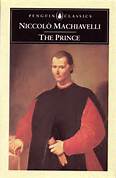 I’ve read The Prince at least three times, hazards of studying political science. This book makes me want to find my copy of it and read it again, now with the understanding of Duke Valentino and who the prince really is.
I only have a couple of issues with the book, but I was able to overlook them. There were portions of the book when Machiavelli and Da Vinci would begin arguing about science and experiments and how to use them to hunt down the murderer. These sections could become a bit…long. There were also portions of Machiavelli’s section where he walked us through every thought process he had on the subject. These too could become overly long. There was also usage of some Italian words, which took me a bit to figure out. I was able to though.
The other caution I have for those who might read this book is the violence against women that was portrayed. If you know the time period, this will come as no shock to you. There are portions that were hard to read with descriptions of sexual violence, physical violence and the emotional violence women had to endure. But, as Damiata herself says, there were but three options for women in this period. Wife, nun or whore. I have great respect for the character Ennis creates in Damiata. She is a woman who took the role given her, whore, and turned it into the opportunity to raise herself well above the place most women were ever able to achieve. I’ll save my thoughts on women having to use their sexuality to hold power over men for another time.
 asked to read The Outsiders by S.E. Hinton for AP English class. This was a book I read in eighth grade and it left an impression on me. So, I decided to revisit some of the books from my past as part of Throwback Thursday.
 Word by Word